How Much Does Invoice Factoring Cost in the UK?
Learn how invoice factoring costs work in the UK, including service fees, discount charges, setup fees and the factors that affect the total cost of invoice finance.
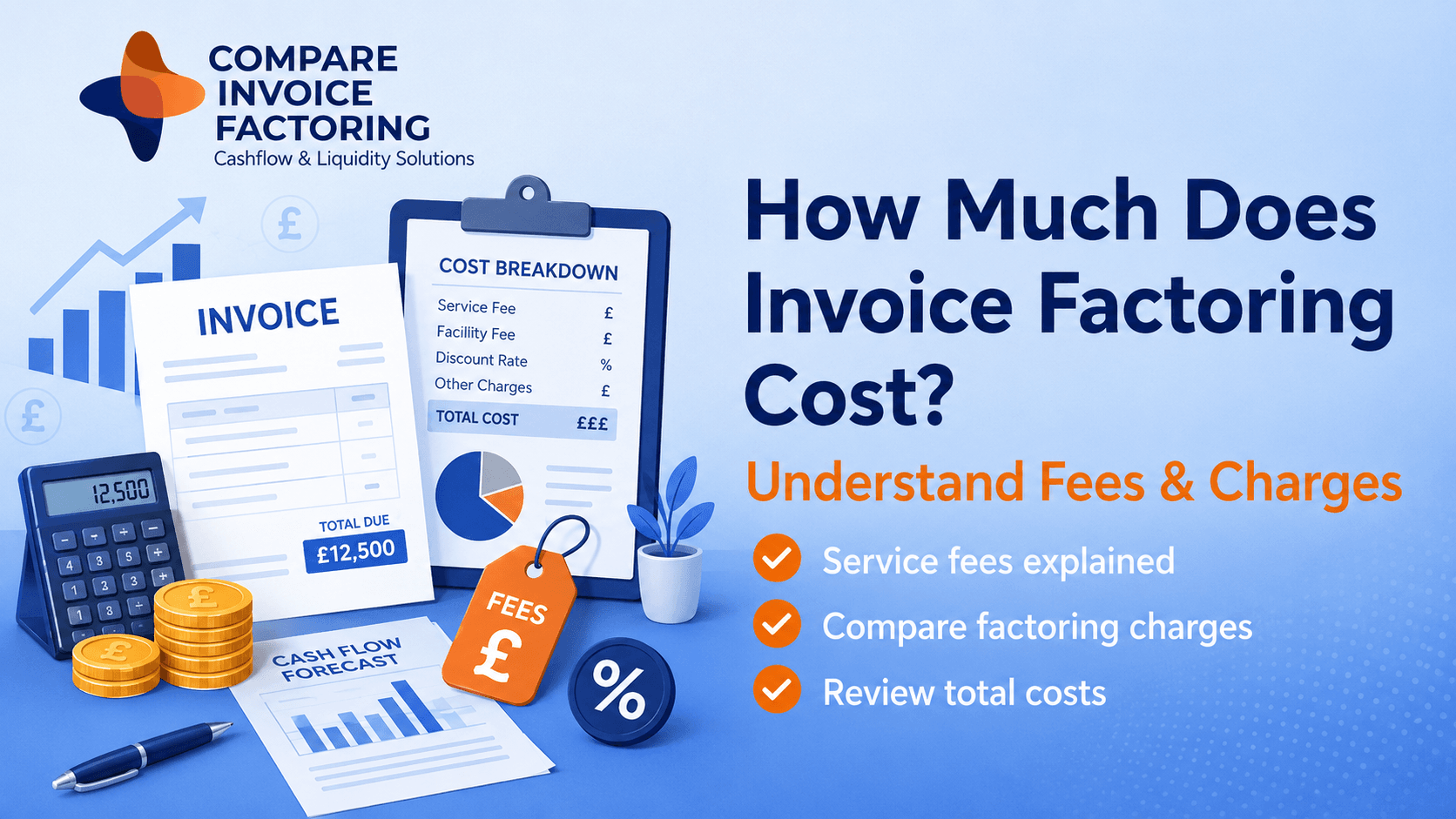
Invoice factoring can be a useful way for UK businesses to improve cash flow, but the cost is not always as simple as one headline rate.
The amount you pay will usually depend on the provider, your invoice values, customer payment terms, business size, sector, funding level and whether you need additional services such as credit control or bad debt protection.
This guide explains how invoice factoring costs work, what fees to look out for and how to compare providers before choosing a facility.
Short answer
Invoice factoring costs usually include a service fee and a discount charge. Some providers may also charge setup fees, minimum monthly fees, credit protection fees, administration charges or early exit fees.
The total cost can vary depending on your turnover, invoice values, customer risk, sector and how long customers take to pay.
When comparing invoice factoring providers, businesses should look beyond the headline rate and ask for a full breakdown of all fees before agreeing to a facility.
What is invoice factoring?
Invoice factoring is a type of invoice finance that allows a business to access money tied up in unpaid invoices.
Instead of waiting for customers to pay on their normal payment terms, the business receives an advance from an invoice factoring provider. The provider then usually manages payment collection from the customer.
Once the customer pays the invoice, the provider releases the remaining balance after deducting agreed fees and charges.
Invoice factoring is often used by businesses that:
- Invoice other businesses
- Have customers on 30, 60 or 90-day payment terms
- Need faster access to working capital
- Want support with credit control
- Have cash flow pressure caused by slow-paying customers
- Are growing and need funding to support larger orders or contracts
It can be especially useful where a business is profitable on paper but does not have enough cash available because customer payments are delayed.
How do invoice factoring costs work?
Invoice factoring costs are usually made up of more than one fee.
The two main costs are:
Service fee
The service fee is usually charged for managing the factoring facility. This may cover administration, account handling, credit control, customer payment collection and ongoing facility management.
This fee may be charged as a percentage of turnover or as a fixed monthly amount, depending on the provider and facility structure.
Discount charge
The discount charge is usually linked to the amount of money advanced to the business and how long that money is borrowed for before the customer pays.
This works in a similar way to interest. The longer the customer takes to pay, the higher the discount charge may become.
Because of this, businesses should not only look at the upfront service fee. Payment speed and customer behaviour can affect the true cost of invoice factoring.
Common invoice factoring fees to check
Before choosing an invoice factoring provider, ask for a full breakdown of every possible cost.
Common fees may include:
- Service fees
- Discount charges
- Setup or arrangement fees
- Monthly minimum fees
- Administration fees
- Credit check fees
- Bad debt protection fees
- CHAPS or payment transfer fees
- Early termination fees
- Renewal fees
- Additional charges for overdue invoices
- Charges for customers paying the wrong account
- Charges linked to disputed invoices
Not every provider charges all of these fees, but it is important to check before signing an agreement.
A provider with a low headline rate may not always be the cheapest option if there are additional charges, minimum fees or restrictive contract terms.
What affects the cost of invoice factoring?
The cost of invoice factoring is usually based on risk, volume and the level of service required.
The main factors that can affect pricing include the following.
Invoice value
Larger invoice values may sometimes attract more competitive rates because the provider is funding higher-value receivables.
Smaller invoice values can be more expensive to manage if they require more administration relative to the amount being funded.
Monthly turnover
Businesses with higher monthly invoice volumes may be able to secure more competitive pricing because the provider is handling a larger facility.
Lower turnover businesses may still be eligible for invoice factoring, but minimum monthly fees can have a bigger impact on the overall cost.
Customer credit quality
The provider will usually consider the creditworthiness of the customers who owe the invoices.
Invoices owed by reliable, established businesses may be viewed as lower risk. Invoices owed by customers with weaker payment histories may cost more to fund or may not be accepted.
Payment terms
If your customers usually pay within 30 days, the discount charge may be lower than if they regularly take 60 or 90 days to pay.
Longer payment terms can increase the total cost because the advance is outstanding for longer.
Sector risk
Some sectors are considered more complex or higher risk than others.
For example, businesses in construction, recruitment or manufacturing may have different payment cycles, dispute risks or customer relationships that influence how providers price the facility.
Recourse or non-recourse factoring
With recourse factoring, the business remains responsible if the customer does not pay.
With non-recourse factoring, the provider may take on more of the bad debt risk, depending on the terms of the agreement.
Non-recourse factoring may cost more because the provider is taking on additional risk.
Level of credit control support
Some businesses want the provider to handle most of the credit control process. Others may only need funding support.
The more service and administration included, the more the facility may cost.
Contract length
Longer contracts may offer different pricing, but they can also reduce flexibility.
Shorter or more flexible arrangements may be useful for businesses that do not want to be tied in, but they may come with different fee structures.
Invoice factoring cost example
The exact cost will vary by provider, but a simple example can help explain how the fees work.
Imagine a business raises a £10,000 invoice and uses invoice factoring to access cash sooner.
The provider advances 85% of the invoice value.
That means the business receives £8,500 upfront.
The customer later pays the full £10,000 invoice to the factoring provider.
The provider then deducts the agreed service fee and discount charge before releasing the remaining balance to the business.
In this example, the final cost depends on:
- The service fee charged by the provider
- The discount charge applied to the advance
- How long the customer takes to pay
- Whether any additional fees apply
- Whether the facility includes extra services such as bad debt protection
This is why two providers can quote different costs for the same business. The advance rate, fee structure, payment timing and contract terms can all change the final amount received.
Invoice factoring rates vs invoice factoring fees
Invoice factoring rates and invoice factoring fees are often discussed together, but they are not always the same thing.
A rate usually refers to the percentage or charge applied to the funding facility.
A fee may refer to a specific cost, such as a service fee, setup fee or administration charge.
When reviewing invoice factoring costs, ask providers to explain:
- The service fee
- The discount charge
- The advance rate
- Any fixed monthly costs
- Any one-off setup costs
- Any minimum monthly requirements
- Any exit or termination fees
- Any charges that apply if customers pay late
The aim is to understand the total cost of the facility, not just the advertised rate.
Are cheaper invoice factoring providers always better?
The cheapest invoice factoring provider is not always the best choice.
A lower fee may be attractive, but the facility still needs to work properly for your business.
A slightly more expensive provider may be better if they offer:
- Faster funding
- Clearer terms
- Better customer support
- Stronger sector experience
- More suitable credit control processes
- Better flexibility
- Higher advance rates
- More transparent pricing
- Better handling of customer relationships
Invoice factoring affects cash flow and customer payment handling, so price should be reviewed alongside service quality and suitability.
Hidden invoice factoring costs to watch out for
Some invoice factoring costs are easy to see upfront. Others may only become clear once the agreement is underway.
Businesses should look carefully for possible hidden or overlooked costs.
These may include:
- Minimum monthly service fees
- Charges for unused facility limits
- Fees for amending the agreement
- Charges for customer credit checks
- Fees for same-day payments
- Charges linked to disputed invoices
- Fees for chasing overdue customers
- Early termination charges
- Automatic renewal clauses
- Additional charges for bad debt protection
- Costs linked to customers paying the wrong account
Before signing, ask the provider to explain when extra charges may apply.
It is also worth asking for a worked example based on your typical invoice values and customer payment terms.
How to reduce invoice factoring costs
There are several ways a business may be able to reduce the cost of invoice factoring.
Compare multiple providers
Different providers may price the same business differently. Comparing more than one quote can help you understand the market and avoid accepting unsuitable terms.
Improve customer payment behaviour
If customers pay faster, the discount charge may be lower because the funding is outstanding for a shorter period.
Negotiate payment terms with customers
Shorter customer payment terms can reduce the time between invoice issue and payment.
Review which invoices you factor
Some businesses may not need to factor every invoice. Depending on the agreement, selective use of invoice finance may help control costs.
Check contract terms carefully
Long contracts, notice periods and early exit fees can increase the real cost of a facility if your needs change.
Keep invoice records accurate
Clear invoicing, accurate customer details and fewer disputes can help reduce delays and avoid unnecessary administration issues.
Choose a provider with sector experience
A provider that understands your industry may offer more suitable terms and avoid problems caused by misunderstanding your payment cycles.
Invoice factoring vs other funding options
Invoice factoring is not the only way to improve business cash flow.
Depending on your situation, you may also consider:
- Invoice discounting
- Business overdrafts
- Business loans
- Revolving credit facilities
- Asset-based lending
- Merchant cash advances
- Supplier payment negotiation
- Internal credit control improvements
Invoice factoring may be useful when unpaid invoices are the main cash flow issue and the business wants faster access to money owed by customers.
However, if your business already has strong credit control, low payment delays or access to cheaper finance, another option may be more suitable.
When invoice factoring may be worth the cost
Invoice factoring may be worth the cost if it helps the business solve a cash flow problem that is restricting growth or creating pressure.
It may be useful when:
- Customers take a long time to pay
- The business needs to cover payroll or supplier costs
- Growth is being limited by slow cash collection
- The business has reliable customers but delayed payments
- Credit control is taking too much internal time
- The business needs flexible funding linked to sales
- Traditional finance is difficult to access
The key question is not only “How much does invoice factoring cost?”
A better question is:
Does the cost make sense compared with the cash flow benefit, time saved and growth opportunity?
When invoice factoring may not be suitable
Invoice factoring may not be the right option for every business.
It may be less suitable if:
- Customers usually pay quickly
- Invoice values are very low
- The business has frequent invoice disputes
- Customer relationships need to be managed very carefully
- The total cost is too high compared with the cash flow benefit
- The business does not want a third party involved in collections
- The contract terms are too restrictive
Before agreeing to a facility, businesses should compare costs, review the contract and make sure the provider’s process fits how they work.
Questions to ask invoice factoring providers
Before choosing a provider, ask clear questions about cost and service.
Useful questions include:
- What is the service fee?
- What is the discount charge?
- How is the discount charge calculated?
- What advance rate can you offer?
- Are there setup fees?
- Are there minimum monthly fees?
- Are there early exit charges?
- How long is the contract?
- What notice period applies?
- Are there charges for credit checks?
- Are there charges for same-day payments?
- What happens if a customer pays late?
- What happens if an invoice is disputed?
- Do you offer recourse or non-recourse factoring?
- Do you offer confidential options?
- Do you have experience in my sector?
- Can you provide a worked cost example?
These questions help make the true cost clearer before you commit.
FAQs
How much does invoice factoring cost?
Invoice factoring costs usually include a service fee and a discount charge. Some providers may also charge setup fees, minimum monthly fees, credit check fees, payment fees or early termination fees. The total cost depends on your business, invoice values, customer payment behaviour and the provider’s terms.
What is a service fee in invoice factoring?
A service fee is usually charged for managing the facility. It may cover administration, account handling, customer collections and credit control support.
What is a discount charge in invoice factoring?
A discount charge is usually linked to the amount of funding advanced and the time it takes for the customer to pay. It works in a similar way to interest on the money advanced.
Are invoice factoring fees fixed?
Some fees may be fixed, while others vary depending on invoice value, funding level or how long customers take to pay. Always ask providers for a full fee breakdown.
Is invoice factoring cheaper than a business loan?
Invoice factoring is not always cheaper than a business loan. It depends on the provider, facility structure and how quickly customers pay. However, invoice factoring may be easier to access for some businesses because it is based on unpaid invoices and customer credit quality.
Can invoice factoring have hidden costs?
Yes, some facilities may include costs that are not obvious from the headline rate. These can include setup fees, minimum monthly fees, credit check charges, same-day payment fees, termination charges or costs linked to disputed invoices.
How can I compare invoice factoring costs?
Compare invoice factoring costs by asking each provider for the service fee, discount charge, advance rate, setup costs, minimum fees, contract length, notice period and any additional charges. You should compare the full facility rather than only the headline rate.
Compare invoice factoring costs
Invoice factoring costs can vary significantly between providers, so it is worth comparing options before choosing a facility.
The best provider is not always the cheapest one. The right choice should balance cost, funding speed, service quality, contract terms and suitability for your business.
Compare Invoice Factoring helps UK businesses understand their options and compare providers with more confidence.
If you are considering invoice factoring, review the full cost carefully and make sure the facility supports your cash flow needs without creating unnecessary long-term restrictions.
How Much Does Invoice Factoring Cost? A Breakdown of Fees
What does invoice factoring cost UK businesses? Invoice factoring typically costs between 0.5% to 5% of the invoice value, plus interest charges of 2-15% above base rate. Most UK businesses pay around 1.5-3% in factoring fees, with additional service charges ranging from £50-500 monthly. Total costs depend on your industry, invoice values, customer creditworthiness, and whether you choose recourse or non-recourse factoring.
Understanding the true cost of invoice factoring can be surprisingly complex. While the headline rates might seem straightforward, there’s often more beneath the surface that catches business owners off guard.
What is Invoice Factoring?
Invoice factoring is a finance solution where you sell your unpaid invoices to a factoring company for immediate cash. Rather than waiting 30, 60, or 90 days for customers to pay, you receive typically 80-90% of the invoice value within 24 hours.
The factoring company then collects payment directly from your customers. Once they’ve paid, you receive the remaining balance minus the factoring fees. It’s particularly valuable for businesses with strong sales but stretched cash flow – a common challenge that affects around 60% of UK SMEs [SOURCE NEEDED].
This isn’t a loan in the traditional sense. You’re not borrowing money against future earnings; you’re selling an asset (your invoice) for immediate cash flow.
How Invoice Factoring Works
The process is more straightforward than many business owners expect:
- Submit your invoices - Upload invoices through the factoring company’s online portal or send them directly
- Receive immediate funding - Get 80-90% of the invoice value transferred to your account within 24 hours
- Customer payment collection - The factoring company handles all credit control and collection activities
- Final settlement - Once your customer pays, you receive the remaining balance minus agreed fees
The entire cycle typically takes 2-3 months from invoice submission to final settlement. During this time, you’ve had access to the majority of your money rather than waiting for customer payments.
What makes this particularly appealing is the speed. Traditional bank loans can take weeks or months to arrange, require extensive documentation, and often need personal guarantees. Invoice factoring decisions are usually made within 48 hours based primarily on your customers’ creditworthiness rather than your business’s financial history.
Benefits of Invoice Factoring
Immediate Cash Flow Relief
The most obvious advantage is speed. When you’ve got payroll to meet, supplier payments due, or growth opportunities requiring quick action, waiting months for invoice payments isn’t viable. Factoring gives you access to 80-90% of your money within a day.
Credit Control Outsourcing
Many business owners underestimate how much time they spend chasing payments. The average UK business spends 16 hours per week on credit control activities [SOURCE NEEDED]. Factoring companies handle this entirely, freeing up your time for revenue-generating activities.
Flexible Finance
Unlike traditional loans with fixed monthly payments, factoring grows with your business. Sell more, factor more. During quieter periods, your costs naturally reduce. There’s no fixed debt on your balance sheet, which can improve your financial ratios for other lending purposes.
Customer Credit Checks
Established factoring companies have sophisticated credit checking systems and industry knowledge. They’ll often spot potential payment problems before you do, helping you make better decisions about which customers to work with.
Costs and Considerations
This is where things get interesting – and sometimes complicated.
Primary Factoring Fees
The main fee ranges from 0.5% to 5% of your invoice value. A manufacturing business with large, reliable customers might pay 1%, while a startup in a volatile sector could face 4-5%. The key factors affecting your rate include:
- Your industry risk profile - Construction and retail typically pay more than professional services
- Customer quality - Invoices to FTSE 100 companies cost less to factor than those to small businesses
- Invoice size - Larger invoices often attract lower percentage fees
- Volume commitment - Higher monthly volumes usually secure better rates
Interest Charges
On top of the factoring fee, you’ll pay interest on the advance from the day you receive it until your customer pays. This typically runs 2-15% above Bank of England base rate, so currently around 7.25-20.25% annually.
Here’s where it gets tricky: if your customer pays in 30 days, you’re only charged interest for 30 days. If they take 90 days, you pay for 90 days. This can significantly impact your total costs.
Additional Service Charges
Most factoring companies charge monthly service fees ranging from £50-500. These cover account management, credit checks, and system access. Some also charge:
- Setup fees - Usually £500-2,000 for new accounts
- Credit check fees - £10-50 per customer credit assessment
- Collection fees - Additional charges for difficult debt recovery
- Early termination fees - Can be substantial if you exit contracts early
Hidden Costs to Watch
The devil’s often in the detail. Some factoring companies charge for:
- Duplicate invoices or administration errors
- Customers paying you directly instead of the factoring company
- Monthly minimum volume requirements
- Currency conversion on international invoices
Comparing Total Costs
Let’s look at a realistic example. A £100,000 invoice with a 2% factoring fee and 10% annual interest rate:
- Factoring fee: £2,000
- 30-day interest (on £80,000 advance): £658
- Monthly service charge: £200
- Total cost: £2,858 (2.86% of invoice value)
If the customer takes 60 days to pay, the interest doubles to £1,316, making total costs £3,516 (3.52% of invoice value).
Compare this to a bank overdraft at 8% annually, which would cost £1,315 for £80,000 over 60 days – but only if your bank will extend that credit, and only if you can wait for customer payments.
Is Invoice Factoring Right for Your Business?
The decision isn’t just about cost – it’s about timing, cash flow patterns, and business priorities.
When Factoring Makes Sense
Growing businesses with payment delays often find factoring invaluable. If you’re winning new contracts but customers pay slowly, factoring can bridge that gap without restricting growth.
Seasonal businesses benefit from the flexibility. A garden centre might factor heavily in spring and summer, then reduce activity in winter without penalty.
Businesses with limited credit history sometimes find factoring more accessible than traditional loans, since approval depends more on customer creditworthiness than your business’s financial track record.
When to Consider Alternatives
If your customers typically pay within 30 days and you have good banking relationships, a business overdraft might be cheaper and simpler.
Businesses with very small invoice values (under £1,000) often find factoring uneconomical due to minimum fees and administrative overhead.
Companies that prefer maintaining direct customer relationships might struggle with factoring, since the factoring company handles all payment collection.
Making the Decision
Consider these questions:
- How much time do you spend on credit control?
- What’s your average payment delay?
- Do you need the cash flow flexibility more than the cost savings?
- Are you comfortable with a third party managing customer payments?
The answer isn’t always obvious. We’ve seen businesses save money overall through factoring because the improved cash flow allowed them to negotiate better supplier terms and take advantage of early payment discounts.
Frequently Asked Questions
What is the difference between recourse and non-recourse factoring?
Recourse factoring means you’re still liable if your customer doesn’t pay – the factoring company can demand the money back from you. Non-recourse factoring transfers the bad debt risk to the factoring company, but costs 0.5-1.5% more. Most UK businesses choose recourse factoring for the lower costs, particularly if they have confidence in their customer base.
How quickly can I access funds through invoice factoring?
Most established factoring companies can advance funds within 24 hours of invoice approval. The initial setup process typically takes 5-10 working days, including credit checks on your customers and documentation review. Emergency funding can sometimes be arranged within hours for urgent cash flow needs, though this may incur additional charges.
What happens if my customer disputes an invoice?
Disputed invoices are typically excluded from funding until resolved. With recourse factoring, you may need to repay any advance if the dispute isn’t resolved in your favour. The factoring company will usually work with you to resolve disputes quickly, as it’s in everyone’s interest to maintain good customer relationships.
Can I choose which invoices to factor?
Most factoring agreements allow selective factoring, meaning you can choose which invoices to submit. However, some companies require you to factor all invoices to certain customers once you start, or maintain minimum monthly volumes. Selective factoring often costs slightly more than whole turnover agreements.
What documentation do I need to start invoice factoring?
You’ll typically need 12-24 months of accounts, recent management accounts, aged debtor reports, and details of your largest customers. The factoring company will also require copies of your standard terms and conditions, and examples of typical invoices. Professional services firms may need additional documentation about client contracts.
How does invoice factoring affect my customer relationships?
The factoring company contacts your customers directly for payment, which some businesses worry about. However, professional factoring companies handle collections diplomatically and often improve payment times through their expertise. Most customers accept factoring as normal business practice, particularly in sectors where it’s common.
What industries are best suited to invoice factoring?
Manufacturing, distribution, recruitment, and professional services work particularly well with factoring. Industries with very small invoice values (under £500), high dispute rates, or customers who typically pay cash may find factoring less suitable. Construction can work but often requires specialist factoring companies due to retention clauses.
Can startups use invoice factoring?
Yes, though they may face higher rates initially. Factoring companies focus more on customer creditworthiness than your business history, making it more accessible than traditional lending for new businesses. However, you’ll typically need at least 3-6 months of trading history and established customer relationships.
What are the typical contract terms for invoice factoring?
Most factoring agreements run for 12-24 months with automatic renewal clauses. Notice periods for termination are typically 1-3 months. Some companies offer month-to-month arrangements but usually at higher rates. Early termination fees can be substantial, often equivalent to 3-6 months of service charges.
How does invoice factoring compare to asset-based lending?
Invoice factoring provides immediate cash against specific invoices, while asset-based lending offers a revolving credit facility secured against your entire debtor book. Factoring includes collection services and typically doesn’t appear as debt on your balance sheet, while asset-based lending gives you more control over customer relationships but requires you to handle all collections.
References and Data Sources
Industry Statistics and Market Data
- UK Finance Alternative Finance Report 2025
- British Business Bank SME Finance Markets Report 2025
- Asset Based Finance Association Annual Survey 2025
Cost and Fee Data
- FCA Consumer Duty Guidance for Invoice Finance 2025
- UK Finance Industry Pricing Benchmarks 2026
- Alternative Business Funding Market Analysis 2025
Regulatory Information
- Financial Conduct Authority Invoice Finance Rules 2025
- UK Finance Code of Conduct for Asset Based Finance 2026
- HM Treasury SME Finance Review 2025
Information accurate as of January 2026. Market conditions and specific terms vary by provider. Costs and fees mentioned are indicative ranges based on industry data and may not reflect current market rates. Always obtain personalised quotes from multiple providers before making financial decisions.
Next Steps
Ready to explore whether invoice factoring could work for your business? The key is comparing quotes from multiple providers, as rates and terms can vary significantly.
Use our free quote comparison tool to get personalised offers from UK factoring companies. You’ll receive competitive quotes within 24 hours, with no obligation and no impact on your credit rating. Simply provide basic details about your business and typical invoice values to get started.
Compare quotes now and discover how much invoice factoring could cost your business – you might be surprised by how affordable it can be when you factor in the time savings and improved cash flow benefits.
Ready to compare factoring providers?
Compare quotes from leading UK factoring providers in 60 seconds. No obligation, completely free.
Ready to Get Started?
Compare quotes from leading UK factoring providers and find the best rates for your business.
Get Your QuotesRelated Articles