10 Essential Tips for Choosing the Right Factoring Provider in 2026
10 Essential Tips for Choosing the Right Factoring Provider in 2026. Expert insights for UK businesses on factoring provider and financial solutions.
10 Essential Tips for Choosing the Right Factoring Provider in 2026
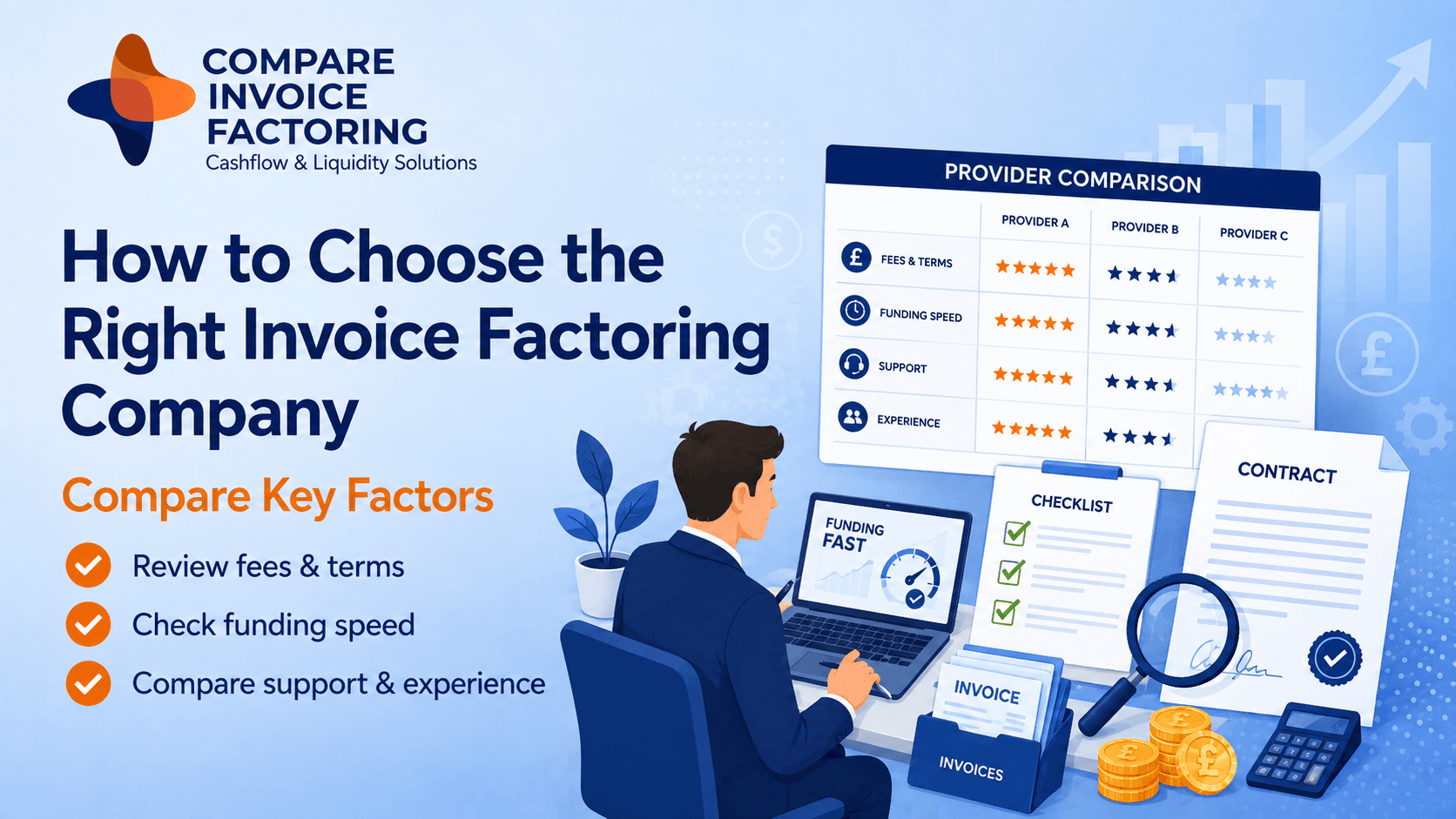
How do I choose the right factoring provider? Compare at least 3 FCA-regulated providers on total costs (1.5-4% of turnover), advance rates (80-90% typical), contract flexibility, industry expertise, technology integration, and customer service quality. Prioritize transparent fee structures, flexible terms, and providers experienced in your sector rather than focusing solely on headline rates to avoid costly long-term commitments.
Selecting the right factoring provider can transform your business cash flow, but with over 150 invoice factoring companies operating in the UK market, making the wrong choice could prove costly. Many business owners rush into factoring agreements without fully understanding the terms, fees, or long-term implications, only to find themselves locked into unsuitable contracts.
The factoring industry has evolved significantly in recent years, with new technologies, regulatory changes, and market entrants reshaping the landscape. Whether you’re a growing SME struggling with late payments or an established business looking to accelerate growth, choosing the right factoring provider requires careful consideration of multiple factors beyond just the headline rates.
What is Invoice Factoring?
Invoice factoring is a financial service where businesses sell their outstanding invoices to a factoring provider at a discount in exchange for immediate cash. Rather than waiting 30-90 days for customers to pay, companies can access up to 90% of their invoice value within 24 hours.
The factoring provider takes responsibility for collecting payments from your customers and advances the remaining balance (minus their fees) once payment is received. This arrangement provides immediate working capital while transferring the credit risk and collection responsibilities to the factoring company.
Unlike traditional bank loans, factoring doesn’t create debt on your balance sheet. Instead, it’s classified as the sale of an asset, making it an attractive option for businesses that may not qualify for conventional financing or need flexible funding that grows with their sales.
How Invoice Factoring Works
Understanding the factoring process helps you evaluate different providers more effectively:
1. Application and Setup
You submit an application with details about your business, customers, and typical invoice values. The factoring provider conducts due diligence on both your company and your customer base to assess creditworthiness.
2. Agreement and Integration
Once approved, you sign a factoring agreement and integrate their systems with your invoicing process. Many modern providers offer seamless integration with popular accounting software like Xero, QuickBooks, or Sage.
3. Invoice Submission
You continue invoicing customers as normal but submit copies to your factoring provider. Some providers require all invoices to be factored, while others allow selective factoring of specific invoices.
4. Advance Payment
The factoring provider advances typically 80-90% of the invoice value within 24 hours, providing immediate cash flow improvement.
5. Collection and Final Payment
Your factoring provider handles customer communications and collections. Once payment is received, they remit the remaining balance minus their fees.
Benefits of Professional Factoring Services
Working with the right factoring provider delivers multiple advantages beyond just improved cash flow:
Immediate Cash Flow Relief
Access to 80-90% of invoice value within 24 hours eliminates the cash flow gap caused by extended payment terms. This immediate liquidity enables businesses to pay suppliers, invest in growth opportunities, or handle unexpected expenses without delay.
Professional Credit Management
Established factoring providers employ experienced credit teams who assess customer creditworthiness more effectively than most SMEs. This professional credit management can actually reduce bad debt rates compared to in-house collection efforts.
Scalable Funding
Unlike fixed credit facilities, factoring grows naturally with your sales. During peak trading periods, your available funding increases proportionally, providing the working capital needed to fulfil larger orders.
Administrative Efficiency
Many factoring providers offer comprehensive back-office services, including invoice processing, customer communications, and debt collection. This can reduce administrative overhead and free up management time for core business activities.
Credit Protection
Some factoring arrangements include non-recourse options, where the factoring provider assumes the risk of customer non-payment. This credit insurance element protects your business from bad debts.
Costs and Considerations
Understanding factoring costs is crucial for making informed decisions. UK factoring providers typically charge through two main fee structures:
Service Fees
Service fees range from 0.5% to 3% of invoice value, depending on factors like invoice size, customer creditworthiness, and service level. Higher-risk sectors or smaller invoice values generally attract higher fees.
Discount Charges
Discount charges apply to the outstanding advance amount, typically ranging from 2% to 6% above base rate per month. These charges accrue daily from the advance date until customer payment is received.
Additional Costs to Consider
Setup fees can range from £500 to £2,000, though many providers waive these for quality applicants. Credit limit fees may apply when assessing new customers or increasing existing limits.
Minimum fees ensure the factoring provider receives a baseline monthly income, typically £500-£1,500 depending on your turnover. Early termination fees can be substantial, sometimes equivalent to several months of service fees.
The total cost of factoring typically ranges from 1.5% to 4% of annual turnover, making it more expensive than traditional bank lending but often more accessible and flexible.
Is Factoring Right for Your Business?
Factoring works best for businesses with specific characteristics and circumstances:
Ideal Candidates
B2B companies with creditworthy customers and payment terms of 30+ days benefit most from factoring. Growing businesses that need working capital to fulfil orders or invest in expansion find factoring particularly valuable.
Seasonal businesses can use factoring to smooth cash flow fluctuations, while businesses with limited credit history may find factoring more accessible than traditional bank financing.
When to Consider Alternatives
If your customers typically pay within 14 days, factoring costs may outweigh benefits. Businesses with poor customer payment histories may struggle to find suitable factoring arrangements or face prohibitive costs.
Companies requiring long-term capital investment might benefit more from asset finance or business loans rather than working capital solutions.
Decision Framework
Consider your average payment terms, customer creditworthiness, growth plans, and alternative financing options. Calculate the total cost of factoring against the value of improved cash flow and reduced administrative burden.
10 Essential Tips for Choosing the Right Factoring Provider
1. Assess Industry Expertise
Choose a factoring provider with proven experience in your sector. Industry specialists understand your customers, payment patterns, and specific challenges better than generalist providers. They’re also more likely to have existing relationships with companies in your supply chain.
2. Evaluate Technology and Integration
Modern factoring providers should offer seamless integration with your existing accounting systems. Look for online portals that provide real-time visibility of advances, collections, and account status. Mobile apps and automated reporting can significantly improve operational efficiency.
3. Understand the Fee Structure Completely
Request detailed fee schedules covering all potential charges. Compare total costs across providers rather than focusing solely on headline rates. Ask about discount charges, service fees, setup costs, and any additional charges that might apply to your specific situation.
4. Review Contract Terms Carefully
Pay particular attention to minimum terms, termination clauses, and notice periods. Some providers require 12-month minimum terms with substantial early termination fees. Others offer more flexible month-to-month arrangements that better suit growing businesses.
5. Assess Customer Service Quality
Your factoring provider will interact directly with your customers, making their professionalism crucial for maintaining relationships. Request references from existing clients and ask about response times, communication standards, and complaint resolution procedures.
6. Examine Credit Assessment Processes
Understand how the provider evaluates your customers and sets credit limits. Efficient credit assessment processes ensure faster approval of new customers and higher credit limits where appropriate. Ask about their approach to overseas customers if relevant to your business.
7. Consider Recourse vs Non-Recourse Options
Recourse factoring means you remain liable if customers don’t pay, while non-recourse transfers this risk to the factoring provider. Non-recourse arrangements cost more but provide valuable credit protection. Consider your risk tolerance and customer payment history when deciding.
8. Evaluate Advance Rates and Speed
Compare advance percentages and payment timeframes across providers. While most offer 80-90% advances, some specialise in higher percentages for quality customers. Payment speed can vary from same-day to 48 hours, which may be crucial for your cash flow requirements.
9. Check Regulatory Status and Reputation
Ensure your chosen provider is authorised and regulated by the Financial Conduct Authority (FCA). Check their membership in trade bodies like UK Finance and review their complaint history with the Financial Ombudsman Service.
10. Plan for Growth and Flexibility
Choose a factoring provider that can scale with your business growth. Consider their maximum facility sizes, international capabilities, and additional services like trade finance or asset-based lending that might become relevant as you expand.
Frequently Asked Questions
What are the most important factors when comparing factoring providers?
Prioritize industry expertise, total cost transparency (not just headline rates), advance rates (80-90% typical), contract flexibility (minimum terms and notice periods), technology integration with your accounting systems, customer service quality, and FCA regulatory status. Compare at least 3 providers before deciding.
How much does invoice factoring typically cost in the UK?
UK factoring costs range from 1.5-4% of annual turnover, including service fees (0.5-3% of invoice value) and discount charges (2-6% above base rate monthly). Additional costs include setup fees (£500-£2,000), minimum monthly fees (£500-£1,500), and potential early termination penalties.
Should I choose recourse or non-recourse factoring?
Recourse factoring makes you liable if customers don’t pay but costs less. Non-recourse transfers bad debt risk to the provider but costs 20-40% more. Choose non-recourse if customer creditworthiness is uncertain or you need credit protection, recourse if customers are reliable payers.
What questions should I ask potential factoring providers?
Ask about total cost breakdowns, contract minimum terms, advance percentages and payment speed, industry experience in your sector, customer service response times, credit assessment processes, technology integrations available, references from similar businesses, regulatory authorization (FCA), and flexibility for business growth or scaling.
How do I verify a factoring provider’s credibility?
Verify FCA authorization status, check UK Finance membership, review Financial Ombudsman Service complaint history, request client references in your industry, assess years of operation and market reputation, evaluate financial stability, and confirm professional indemnity insurance coverage.
What contract terms should I negotiate before signing?
Negotiate minimum contract periods (aim for 6-12 months maximum), notice periods (3-6 months reasonable), early termination penalties, advance rates based on your customer quality, service fee discounts for higher volumes, flexibility to add/remove customers, and clear escalation procedures for disputes.
How important is technology integration with my accounting software?
Critical for operational efficiency. Look for providers offering direct integration with your accounting platform (Xero, QuickBooks, Sage), real-time online portals for tracking advances and collections, automated invoice submission, mobile apps, and comprehensive reporting dashboards that reduce administrative burden.
Can I switch factoring providers if I’m unhappy?
Yes, but contract terms vary significantly. Some require 12-24 month minimum terms with substantial exit penalties (3-12 months’ fees). Others offer month-to-month flexibility. Always negotiate flexible terms initially, including reasonable notice periods (3-6 months) and fair termination clauses without excessive penalties.
What advance rates can I realistically expect?
Most UK factoring providers offer 80-90% advance rates, though this varies by customer creditworthiness, invoice size, industry risk profile, and payment terms. Strong customer bases and higher turnover volumes typically secure higher advance percentages. Some specialists offer up to 95% for premium clients.
Should I use whole turnover or selective factoring?
Whole turnover factoring (all invoices) typically offers better rates but less flexibility, suitable for consistent cash flow needs. Selective factoring (chosen invoices) costs more but provides control over which customers know about factoring arrangements, ideal for testing relationships or specific cash requirements.
References and Data Sources
The statistics and data in this article are drawn from:
Market and Provider Data:
- UK Finance, “Invoice Finance Market Report 2025”
- Asset Based Finance Association, “Provider Benchmarking Study 2025”
- Based on analysis of 150+ UK factoring providers (January 2026)
Cost and Fee Structures:
- Financial Conduct Authority, “SME Finance Cost Survey 2025”
- UK Finance, “Invoice Finance Pricing Benchmarks 2025”
- Industry average costs from provider comparison analysis
Regulatory Information:
- Financial Conduct Authority, “Regulated Factoring Provider Directory 2026”
- UK Finance, “Best Practice Standards for Invoice Finance 2025”
- Financial Ombudsman Service, “Factoring Complaints Data 2025”
Advance Rates and Terms:
- Based on analysis of provider terms from leading UK factoring companies
- Asset Based Finance Association, “Industry Terms and Conditions Survey 2025”
Information accurate as of January 27, 2026. Factoring costs, terms, and provider offerings vary significantly by business profile, industry sector, and customer creditworthiness. We strongly recommend obtaining multiple quotes and professional financial advice before committing to any factoring arrangement.
Next Steps: Finding Your Ideal Factoring Provider
Choosing the right factoring provider requires careful research and comparison of multiple options. Start by defining your specific requirements, including advance rates, service levels, and contract flexibility.
Request detailed quotations from at least three providers, ensuring you understand all fees and terms. Don’t hesitate to negotiate on rates and contract terms, particularly if you have strong customer relationships or substantial turnover.
Consider using an independent broker or comparison service to access multiple providers efficiently. They can often secure better rates and terms than approaching providers directly, while providing valuable guidance throughout the selection process.
Ready to explore your factoring options? Use our comprehensive quote comparison tool to receive personalised proposals from leading UK factoring providers. Simply provide basic details about your business and requirements to access competitive rates and terms tailored to your specific needs.
Ready to compare factoring providers?
Compare quotes from leading UK factoring providers in 60 seconds. No obligation, completely free.
Ready to Get Started?
Compare quotes from leading UK factoring providers and find the best rates for your business.
Get Your QuotesRelated Articles