How to Choose the Right Invoice Factoring Company
Learn how to choose the right invoice factoring company by comparing fees, contract terms, funding speed, sector experience, credit control and customer support.
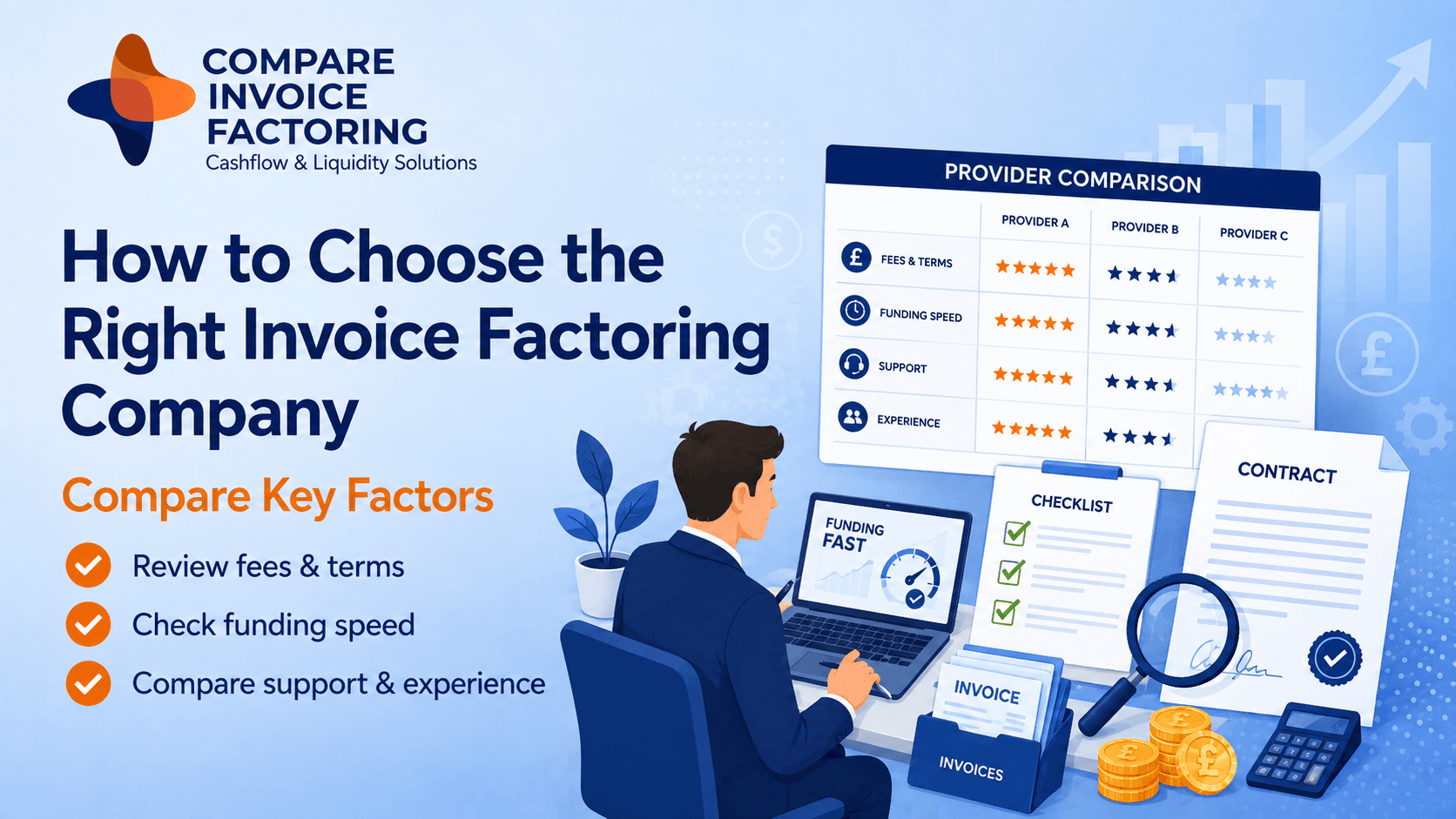
Choosing the right invoice factoring company is not only about finding the lowest fee. The provider you choose can affect your cash flow, customer relationships, contract flexibility and how smoothly your finance facility works day to day.
The right invoice factoring company should understand your sector, explain costs clearly, provide suitable funding limits and handle collections in a way that supports your business.
This guide explains the key factors to compare before choosing an invoice factoring provider.
Short answer
When choosing an invoice factoring company, compare the full cost of the facility, funding speed, advance rates, contract terms, sector experience, customer collection process and support quality.
The best provider is not always the cheapest one. A slightly higher fee may be worthwhile if the provider offers clearer terms, faster funding, stronger customer service and better understanding of your industry.
Before signing, ask each provider for a full fee breakdown, contract summary and worked example based on your typical invoice values and customer payment terms.
What is an invoice factoring company?
An invoice factoring company provides funding against unpaid invoices.
Instead of waiting for customers to pay, your business receives an advance against eligible invoices. The factoring provider then usually manages customer payment collection and releases the remaining balance once the customer pays, after deducting agreed fees.
Invoice factoring is commonly used by businesses that:
- Sell to other businesses
- Raise invoices on payment terms
- Wait 30, 60 or 90 days for customers to pay
- Need faster access to working capital
- Want support with credit control
- Are growing but need cash flow support
- Have reliable customers but delayed payments
Choosing the right provider matters because invoice factoring is not just a finance product. It can also affect customer communication, collections, administration and long-term flexibility.
Why choosing the right provider matters
Invoice factoring companies can differ significantly in how they structure fees, manage customer relationships and support businesses.
A suitable provider can help improve cash flow, reduce time spent chasing payments and support business growth.
An unsuitable provider may create problems such as:
- Higher costs than expected
- Restrictive contract terms
- Poor communication
- Slow funding
- Customer collection issues
- Unclear fees
- Limited flexibility
- Difficulty exiting the agreement
That is why it is important to compare more than the headline rate before choosing a provider.
Compare the full cost
Cost is one of the most important areas to review, but it should not be judged only by the headline fee.
Invoice factoring costs may include:
- Service fees
- Discount charges
- Setup fees
- Monthly minimum fees
- Administration fees
- Credit check fees
- Payment transfer fees
- Bad debt protection fees
- Early exit charges
- Renewal fees
- Charges linked to disputed or overdue invoices
Some providers may look cheaper at first but become more expensive once all fees are included.
Before choosing a provider, ask for:
- A full fee schedule
- A worked example using your invoice values
- Details of any minimum monthly fees
- Details of any setup or exit fees
- Confirmation of how discount charges are calculated
- A clear explanation of when extra charges apply
The goal is to understand the total cost of the facility, not just the advertised rate.
Check the advance rate
The advance rate is the percentage of each invoice value that the provider can release upfront.
For example, if a provider offers an 85% advance rate on a £10,000 invoice, the business may receive £8,500 upfront before fees are deducted later.
A higher advance rate can improve cash flow, but it should still be reviewed alongside the full cost and contract terms.
When comparing advance rates, ask:
- What percentage of invoice value can be advanced?
- Does the advance rate vary by customer?
- Are some invoices excluded?
- Does the rate change if customers pay late?
- Are there different rates for different sectors?
- Are there limits on total funding available?
The best advance rate is not always the highest one. It should be suitable for your cash flow needs and affordable once fees are included.
Review funding speed
One of the main reasons businesses use invoice factoring is to access cash faster.
However, funding speed can vary between providers.
Some providers may release funds quickly once the facility is set up, while others may have slower checks, approval steps or payment processes.
Before choosing a provider, ask:
- How quickly can funds be released after invoice submission?
- How long does the initial setup take?
- Are same-day payments available?
- Are there extra fees for faster payments?
- What checks are required before invoices are funded?
- Does funding speed depend on customer approval?
Funding speed is especially important if your business uses invoice factoring to cover payroll, supplier payments or growth-related costs.
Compare contract terms
Contract terms can have a major impact on whether invoice factoring remains suitable over time.
A facility may look attractive at the start, but restrictive terms can create problems if your business changes direction or finds a better option later.
Key contract areas to check include:
- Contract length
- Notice period
- Renewal terms
- Early exit charges
- Minimum monthly fees
- Minimum invoice volume
- Personal guarantees
- Exclusivity terms
- Whether all invoices must be factored
- Whether selective factoring is allowed
Avoid focusing only on monthly cost. A provider with flexible contract terms may be more suitable than a cheaper provider with restrictive conditions.
Check sector experience
Invoice factoring can work differently across industries.
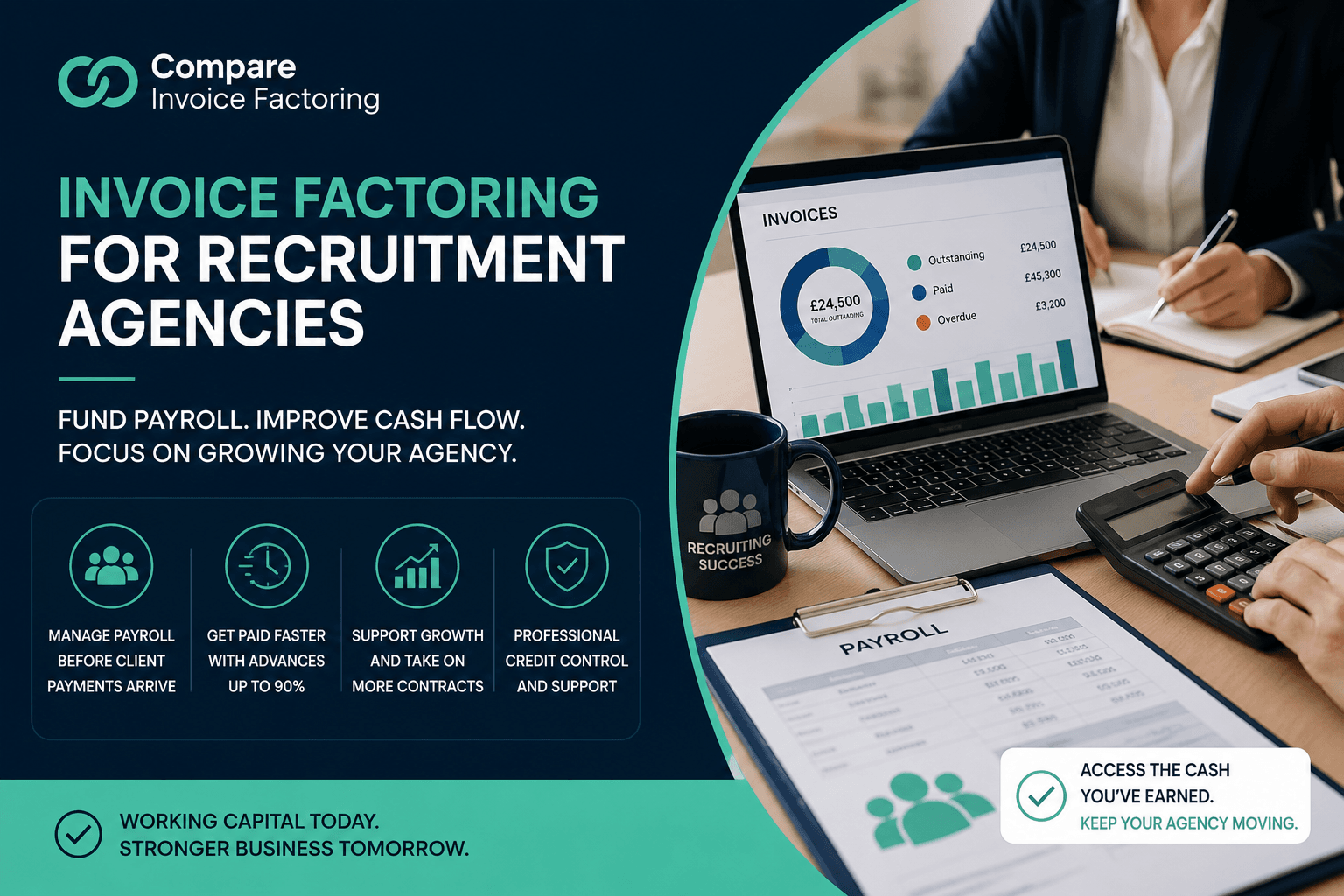
A recruitment agency may need funding to cover payroll before clients pay. A manufacturer may need cash flow support for materials, production cycles and supplier payments. A construction business may face staged payments, retentions and longer payment terms.
A provider with sector experience may better understand:
- Typical payment cycles
- Customer expectations
- Invoice values
- Dispute risks
- Seasonal cash flow pressures
- Credit control requirements
- Common funding challenges
When comparing providers, ask whether they regularly work with businesses in your sector.
Sector knowledge can make the facility smoother and reduce the chance of unsuitable terms or misunderstandings.
Understand the customer collection process
With invoice factoring, the provider usually manages customer payment collection.
This can be helpful if your business wants support with credit control, but it also means the provider’s approach can affect customer relationships.
Before choosing a provider, ask:
- How will customers be contacted?
- Will collections be handled under the provider’s name?
- How often will customers receive reminders?
- What happens if a customer pays late?
- How are disputes handled?
- Can you review communication templates?
- Will you have visibility over collection activity?
- Who manages sensitive customer issues?
A professional collection process should be clear, respectful and aligned with how you want customers to be treated.
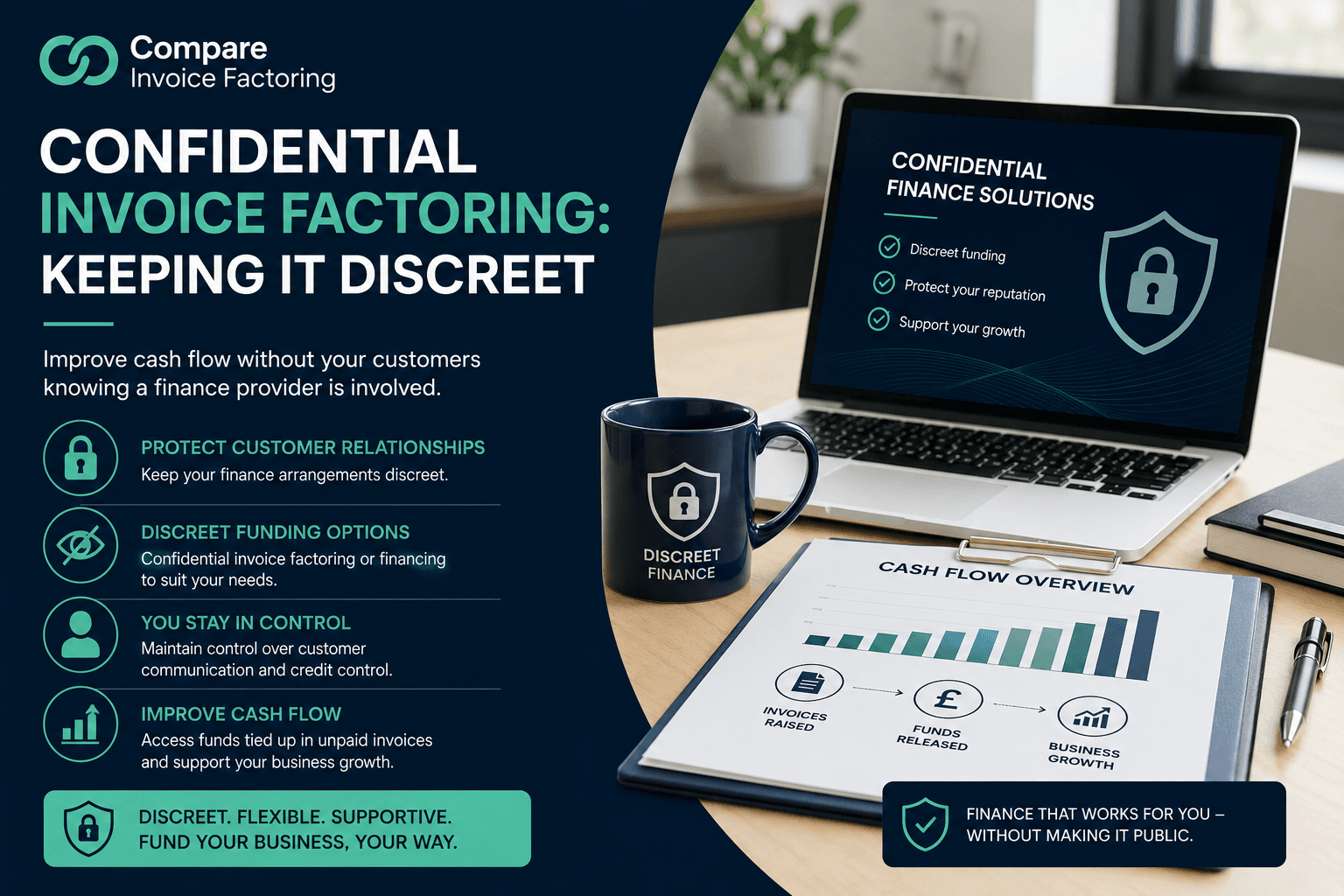
Consider confidential options
Some businesses are comfortable with customers knowing that an invoice factoring provider is involved. Others may prefer a more discreet arrangement.
Traditional invoice factoring is usually disclosed, meaning customers may know that the provider is collecting payment.
Confidential invoice finance or invoice discounting may be more suitable if you want to keep control over customer communication.
Ask providers:
- Is the facility disclosed or confidential?
- Will customers know a finance provider is involved?
- Are confidential options available?
- Is invoice discounting more suitable?
- What criteria are needed for confidential finance?
- How will payments be collected?
If confidentiality matters, discuss it early. Not every provider or facility will be suitable.
Review support quality
Customer support is easy to overlook during the comparison stage, but it can become very important once the facility is live.
Good support can help resolve funding issues, customer queries, invoice problems and account questions quickly.
When reviewing support quality, ask:
- Will you have a dedicated account manager?
- How quickly does the provider respond?
- Can you speak to someone by phone?
- Is support available by email or portal?
- How are urgent payment issues handled?
- How are invoice disputes managed?
- How often will reporting be provided?
A provider may have competitive fees but still be difficult to work with if communication is slow or unclear.
Check technology and reporting
Many invoice factoring providers use online portals to manage invoice submission, funding updates and customer payment activity.
A good system should make the process easier, not more complicated.
Check whether the provider offers:
- Online invoice submission
- Real-time funding updates
- Customer payment tracking
- Clear account statements
- Downloadable reports
- Visibility over fees and charges
- Easy access to support
- Integration options if needed
Poor systems can create extra administration and make it harder to understand the facility.
Look at recourse and non-recourse options
Invoice factoring can be offered on a recourse or non-recourse basis.
Recourse factoring
With recourse factoring, your business remains responsible if the customer does not pay. This can be cheaper, but the bad debt risk stays with the business.
Non-recourse factoring
With non-recourse factoring, the provider may take on more of the bad debt risk, depending on the agreement. This may cost more and can come with specific conditions.
Before choosing, ask:
- Is the facility recourse or non-recourse?
- What happens if a customer does not pay?
- Are there exclusions?
- Is bad debt protection included?
- What additional cost applies?
- Which customers are covered?
The right choice depends on your appetite for risk, customer quality and cost sensitivity.
Watch out for hidden fees
Hidden or overlooked fees can make invoice factoring more expensive than expected.
Common costs to check include:
- Setup charges
- Minimum monthly fees
- Credit check fees
- Administration fees
- Same-day payment fees
- Charges for disputed invoices
- Fees for customers paying the wrong account
- Bad debt protection charges
- Early termination fees
- Renewal charges
- Charges for unused facility limits
Ask the provider to explain every possible fee before signing.
It is also worth asking:
“Are there any circumstances where additional charges would apply?”
A transparent provider should be able to answer this clearly.
Questions to ask before choosing a provider
Before choosing an invoice factoring company, ask practical questions about cost, service and contract terms.
Useful questions include:
- What is the service fee?
- What is the discount charge?
- How is the discount charge calculated?
- What advance rate can you offer?
- How quickly can funds be released?
- Are there setup fees?
- Are there minimum monthly fees?
- Are there early exit fees?
- How long is the contract?
- What notice period applies?
- Can I factor selected invoices only?
- Will customers know I am using invoice factoring?
- Who handles customer collections?
- How are disputes handled?
- Do you offer confidential options?
- Do you work with businesses in my sector?
- Will I have a dedicated account manager?
- Can you provide a worked example?
- Can I see the full fee schedule?
These questions make it easier to compare providers properly and avoid surprises later.
Signs of a good invoice factoring company
A good invoice factoring company should be transparent, responsive and realistic about whether the facility is suitable.
Positive signs include:
- Clear explanation of fees
- Transparent contract terms
- Fast but responsible approval process
- Experience in your sector
- Professional customer collection approach
- Clear reporting
- Practical support
- Realistic funding limits
- No pressure to sign quickly
- Willingness to provide worked examples
- Clear explanation of risks and limitations
The right provider should help you make an informed decision, not rush you into an agreement.
Warning signs to avoid
Be careful if a provider is unclear about costs, contract terms or customer handling.
Warning signs may include:
- Vague fee explanations
- Pressure to sign quickly
- Unclear exit terms
- Long contracts without flexibility
- Poor communication during the sales process
- No clear contact person
- Reluctance to provide a full fee schedule
- Unclear customer collection process
- Limited sector understanding
- Overpromising on funding levels
If the provider is difficult to deal with before you sign, the relationship may become harder once the facility is live.
Invoice factoring company vs invoice finance broker
Businesses can approach invoice factoring companies directly or use a broker/comparison service.
Going direct to a provider
Going direct can work well if you already know which provider is suitable and understand the terms being offered.
Using a broker or comparison service
A broker or comparison service may help you review multiple providers more quickly. This can be useful if you are unsure which provider fits your business, sector or funding needs.
When using a broker or comparison service, check:
- Which providers are compared
- Whether the service is independent
- How the service is paid
- Whether you can review multiple options
- Whether the recommendation is based on your business needs
The key is to compare suitable options, not simply accept the first quote.
FAQs
How do I choose the right invoice factoring company?
Choose an invoice factoring company by comparing costs, advance rates, funding speed, contract terms, sector experience, customer collection process and support quality. Ask for a full fee breakdown and a worked example before agreeing to a facility.
What should I look for in an invoice factoring provider?
Look for transparent pricing, suitable funding limits, flexible contract terms, professional credit control, sector experience and clear support. The provider should explain both the benefits and limitations of the facility.
Is the cheapest invoice factoring company the best?
Not always. The cheapest provider may not offer the best support, flexibility or customer handling. A slightly higher fee may be worthwhile if the provider offers better service, clearer terms and faster funding.
Should I choose invoice factoring or invoice discounting?
Invoice factoring may be better if you want funding and support with customer collections. Invoice discounting may be better if you want to keep more control over collections and keep the arrangement less visible to customers.
Will customers know I am using invoice factoring?
In traditional invoice factoring, customers usually know that a provider is involved because the provider manages collections. Confidential invoice finance or invoice discounting may be available if you want a more discreet option.
What questions should I ask an invoice factoring company?
Ask about service fees, discount charges, advance rates, setup fees, minimum fees, contract length, notice periods, customer collections, dispute handling, confidential options and sector experience.
Can I switch invoice factoring providers?
In many cases, yes, but it depends on your contract. Check notice periods, early exit fees, renewal terms and any restrictions before trying to switch providers.
Compare invoice factoring providers
Choosing the right invoice factoring company can make a significant difference to your cash flow, customer relationships and overall cost of finance.
The best provider should match your funding needs, sector, customer base and preferred way of managing collections.
Compare Invoice Factoring helps UK businesses understand their options and compare providers more confidently.
Before choosing a provider, review the full cost, check the contract terms and make sure the facility is suitable for how your business operates.
Ready to compare factoring providers?
Compare quotes from leading UK factoring providers in 60 seconds. No obligation, completely free.
Ready to Get Started?
Compare quotes from leading UK factoring providers and find the best rates for your business.
Get Your QuotesRelated Articles