Confidential Invoice Factoring: Keeping It Discreet
Learn how confidential invoice factoring and invoice finance options work, when discretion matters and what businesses should compare before choosing a provider.
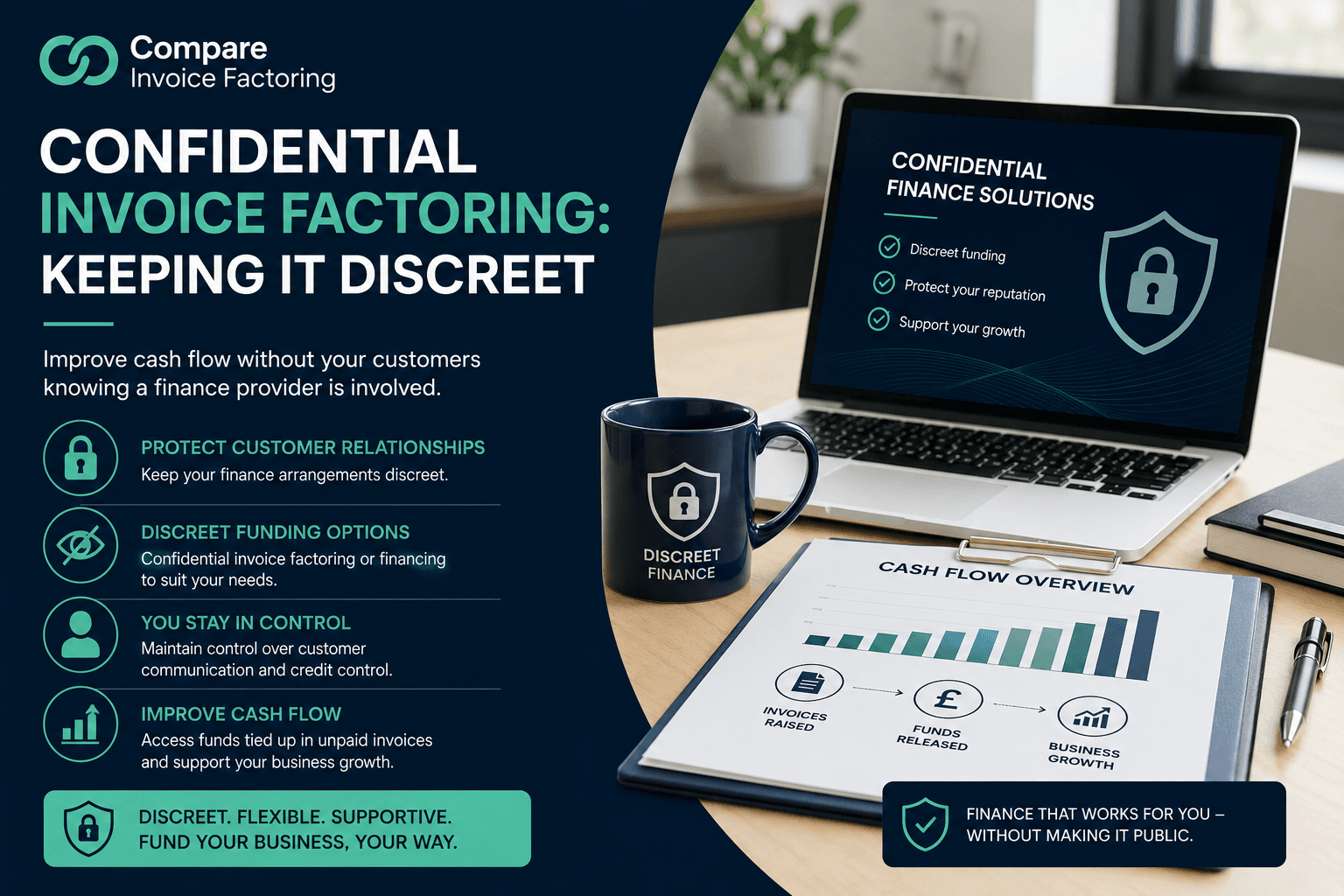
Some businesses want to improve cash flow without making their customers aware that a finance provider is involved.
Confidential invoice factoring and confidential invoice finance options may help businesses access funding against unpaid invoices while keeping the arrangement more discreet, depending on the provider and facility structure.
This guide explains how confidential invoice factoring works, when it may be suitable and what to compare before choosing a provider.
Short answer
Confidential invoice factoring is designed to help businesses access funding against unpaid invoices while keeping the finance arrangement less visible to customers.
However, traditional invoice factoring is often disclosed because the provider may handle customer collections. If confidentiality is very important, invoice discounting or another confidential invoice finance facility may be more suitable.
Businesses should compare providers carefully and ask how customer communication, payment collection and account handling will work before choosing a confidential facility.
What is confidential invoice factoring?
Confidential invoice factoring is a type of invoice finance where a business accesses funding against unpaid invoices while trying to keep the arrangement discreet.
The aim is to improve cash flow without making the finance provider’s involvement obvious to customers.
In practice, the level of confidentiality depends on:
- The provider
- The type of facility
- How customer payments are collected
- Whether collections are handled by the provider or the business
- Whether customer communication is branded or discreet
- The risk profile of the business
- The strength of internal credit control
Because of this, it is important to ask each provider exactly how confidentiality is handled.
Confidential factoring vs standard invoice factoring
Standard invoice factoring is usually disclosed.
This means customers may know that an invoice finance provider is involved, especially if the provider collects payment directly or sends payment instructions.
Confidential factoring is different because the provider may structure the facility so the finance arrangement is less visible.
The key difference is customer visibility.
With standard invoice factoring:
- The provider may contact customers directly
- Customers may pay the provider
- Payment instructions may show the provider’s details
- The provider may manage credit control
- The arrangement is usually more visible
With confidential invoice finance:
- Customer communication may remain under the business name
- Payment collection may be handled more discreetly
- The customer may not clearly see that a finance provider is involved
- The business may retain more control over customer relationships
- The facility may require stronger internal processes
If customer perception matters, this difference is important.
Confidential factoring vs invoice discounting
Confidential invoice discounting is often more common than confidential invoice factoring.
This is because invoice discounting usually allows the business to retain more control over customer collections.
With invoice factoring, the provider often manages credit control and collections. That can make confidentiality harder.
With invoice discounting, the business usually keeps control over customer contact and payment chasing, which can make the arrangement easier to keep discreet.
Invoice factoring
Invoice factoring may be suitable if the business wants funding and support with customer collections.
Invoice discounting
Invoice discounting may be suitable if the business wants funding but prefers to manage customer relationships and collections internally.
The right choice depends on how much control the business wants, whether it has strong credit control and how important confidentiality is.
Why businesses choose confidential invoice finance
Businesses may choose confidential invoice finance because they want to improve cash flow without changing how customers perceive the business.
Common reasons include:
- Protecting customer relationships
- Avoiding concerns about financial stability
- Maintaining control over communication
- Keeping collections in-house
- Preserving brand perception
- Supporting growth quietly
- Avoiding disruption to existing payment processes
- Keeping finance arrangements private from customers
For some businesses, confidentiality is not only a preference. It is a key part of maintaining trust with clients.
When confidentiality matters most
Confidentiality may be especially important where customer relationships are sensitive or long-term.
It may matter more for businesses that:
- Work with a small number of key clients
- Have high-value customer relationships
- Operate in professional services
- Have customers who may question third-party collection involvement
- Want to maintain direct control over credit control
- Have a strong internal finance team
- Are concerned about brand perception
- Work in sectors where trust and discretion are important
If customers are likely to be comfortable with disclosed factoring, confidentiality may be less important.
But if customer perception could affect relationships, a discreet option may be worth considering.
How confidential invoice finance works
The exact process depends on the provider, but confidential invoice finance usually follows a structure like this.
The business raises an invoice
The business raises an invoice to the customer as normal.
The invoice is submitted for funding
The invoice is submitted to the invoice finance provider. The provider reviews the invoice and checks whether it is eligible for funding.
Funds are advanced
The provider advances a percentage of the invoice value to the business.
Customer payment is collected
Depending on the facility, the customer may pay into an account that appears to be controlled by the business, even though it may be linked to the finance arrangement.
The remaining balance is released
Once the customer pays, the provider deducts agreed fees and releases the remaining balance to the business.
The important detail is how the customer payment process is set up. This is what determines whether the arrangement is genuinely discreet.
What to ask providers about confidentiality
Before choosing a confidential invoice finance provider, ask direct questions about how the facility works.
Useful questions include:
- Will customers know a finance provider is involved?
- Who sends payment reminders?
- Who manages credit control?
- What bank details will customers see?
- Will customer communication use our business name?
- Will invoices need to include any provider wording?
- What happens if a customer pays late?
- What happens if a customer disputes an invoice?
- Are confidential options available from day one?
- What criteria do we need to meet?
- Is invoice discounting more suitable than factoring?
- Can we review the customer communication process?
- Are there any situations where confidentiality could be broken?
Do not assume a facility is confidential just because it is described as discreet. Ask the provider to explain exactly how it works.
Eligibility for confidential invoice finance
Not every business will qualify for confidential invoice finance.
Providers may want to see that the business can manage customer relationships and credit control properly.
Eligibility may depend on:
- Trading history
- Turnover
- Invoice values
- Customer quality
- Internal credit control processes
- Payment history
- Sector
- Financial stability
- Level of invoice disputes
- Strength of administration and reporting
A provider may be more comfortable offering confidential finance to businesses that have strong systems and reliable customers.
If a business has weak credit control or frequent disputes, the provider may prefer a disclosed factoring arrangement.
Benefits of confidential invoice factoring
Confidential invoice factoring or confidential invoice finance can offer several benefits.
These may include:
- Improved cash flow
- Faster access to money tied up in invoices
- More discreet customer handling
- Better control over client relationships
- Reduced visibility of external finance
- Support for growth
- Less pressure from slow-paying customers
- A facility linked to sales activity
For businesses that want funding without changing the customer experience too much, confidentiality can be valuable.
Drawbacks and limitations
Confidential invoice finance may not be suitable for every business.
Possible limitations include:
- It may cost more than standard disclosed factoring
- Eligibility criteria may be stricter
- The business may need stronger internal credit control
- Not every provider offers confidential options
- Some facilities may still require specific payment processes
- Confidentiality may not apply in every situation
- Late payments or disputes may create complications
- The facility may be less suitable for businesses with weak admin processes
The key is to understand the trade-off between discretion, cost, control and provider requirements.
Costs to consider
The cost of confidential invoice factoring or invoice finance will depend on the provider and facility type.
Common costs may include:
- Service fees
- Discount charges
- Setup fees
- Monthly minimum fees
- Administration fees
- Credit check fees
- Payment transfer fees
- Bad debt protection fees
- Early exit charges
- Charges linked to disputed invoices
Confidential facilities may sometimes cost more because the provider may need to manage the arrangement differently or take on additional complexity.
Before signing, ask for:
- A full fee schedule
- A worked example
- Details of minimum fees
- Confirmation of setup costs
- Details of exit charges
- Explanation of when extra charges apply
The lowest headline rate is not always the best option if the facility does not protect customer relationships properly.
Confidential invoice finance and customer relationships
One of the main reasons businesses consider confidential invoice finance is to protect customer relationships.
If customers are used to dealing directly with your business, a sudden change in payment collection may raise questions.
A confidential facility may help maintain a more consistent customer experience.
However, this depends on the provider and setup.
Before choosing a facility, check:
- How payment instructions will appear
- Whether customer reminders are sent
- Who handles late payments
- How disputes are managed
- Whether the provider contacts customers directly
- Whether communication can stay under your business name
The provider’s process should match the level of discretion your business needs.
When confidential invoice finance may be useful
Confidential invoice finance may be useful when a business needs cash flow support but does not want customers to be aware of external finance involvement.
It may be suitable when:
- Customer relationships are sensitive
- The business has strong internal credit control
- The business wants to maintain direct communication
- Clients may react negatively to third-party collections
- The business wants funding to support growth
- Slow payments are causing cash flow pressure
- The business has reliable customers
- The business wants to keep finance arrangements private
It can be a strong option where discretion and control are both important.
When it may not be suitable
Confidential invoice finance may not be suitable if the business does not have the processes needed to manage collections properly.
It may be less suitable when:
- Customer payments are often disputed
- Credit control is weak
- Administration is inconsistent
- Customers regularly pay late
- The business wants the provider to handle collections
- The cost is too high
- A disclosed facility would be acceptable
- Eligibility requirements are not met
In some cases, standard invoice factoring may be more practical if the business wants the provider to manage collections directly.
What to compare before choosing a provider
When comparing confidential invoice factoring or invoice finance providers, look at the full facility rather than only the cost.
Key areas to compare include:
- Level of confidentiality
- Customer communication process
- Funding speed
- Advance rate
- Service fees
- Discount charges
- Setup costs
- Contract length
- Notice period
- Early exit charges
- Credit control requirements
- Online portal and reporting
- Sector experience
- Support quality
- Dispute handling process
The right provider should clearly explain what is confidential, what is not and when customer visibility may occur.
FAQs
What is confidential invoice factoring?
Confidential invoice factoring is a type of invoice finance designed to provide funding against unpaid invoices while keeping the arrangement less visible to customers. The exact level of confidentiality depends on the provider and facility structure.
Is invoice factoring always confidential?
No. Traditional invoice factoring is often disclosed because the provider may handle customer collections. If confidentiality is important, ask about confidential invoice finance or invoice discounting.
What is the difference between confidential factoring and invoice discounting?
Invoice factoring usually includes funding and customer collections support. Invoice discounting usually allows the business to retain more control over collections, which can make it easier to keep the facility confidential.
Will my customers know I am using invoice finance?
This depends on the facility. With disclosed factoring, customers may know. With confidential invoice finance, the arrangement may be less visible. Always ask the provider how payments and customer communication will be handled.
Does confidential invoice factoring cost more?
It can cost more depending on the provider, facility type and level of discretion required. Businesses should compare the full cost, not only the headline rate.
Who is eligible for confidential invoice finance?
Eligibility depends on the provider. Businesses with strong credit control, reliable customers, good administration and stable trading history may be more likely to qualify.
Is confidential invoice finance suitable for small businesses?
It may be suitable for some small businesses, but eligibility and cost will depend on turnover, customer quality, invoice values and internal processes. Some small businesses may find standard factoring more accessible.
Compare confidential invoice factoring options
Confidential invoice factoring and confidential invoice finance can help businesses improve cash flow while keeping customer relationships more discreet.
The right option depends on your need for funding, your internal credit control, customer relationships and how important confidentiality is.
Compare Invoice Factoring helps UK businesses understand their invoice finance options and compare providers with more confidence.
Before choosing a provider, ask exactly how confidentiality works, what fees apply and whether invoice factoring or invoice discounting is the better fit for your business.
Ready to compare factoring providers?
Compare quotes from leading UK factoring providers in 60 seconds. No obligation, completely free.
Ready to Get Started?
Compare quotes from leading UK factoring providers and find the best rates for your business.
Get Your QuotesRelated Articles